01The great walled city on the Aude — Cathar wars, contested stones, and a restoration that still divides opinion
Other fortified towns have walls; Carcassonne has two complete circuits of ramparts, one nested inside the other.
02A City in Silhouette
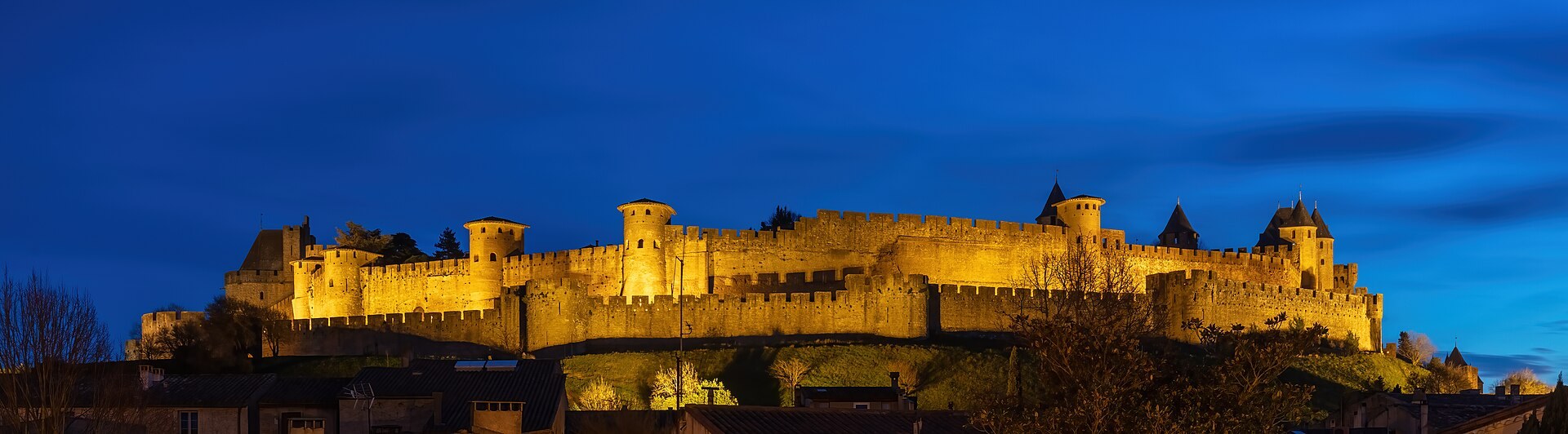
Seen from the motorway at dusk, Carcassonne does something that few medieval monuments manage: it stops you cold. The double ring of crenellated walls, the fifty-odd towers, the conical slate caps catching the last light — all of it sits above the Aude valley with the composed authority of a place that has been defended, besieged, lost, regained and argued over for the best part of two millennia. Romans fortified this hill. Visigoths refined the work. The counts of Trencavel made it one of the most powerful lordships in the medieval Midi. And then the crusaders came.
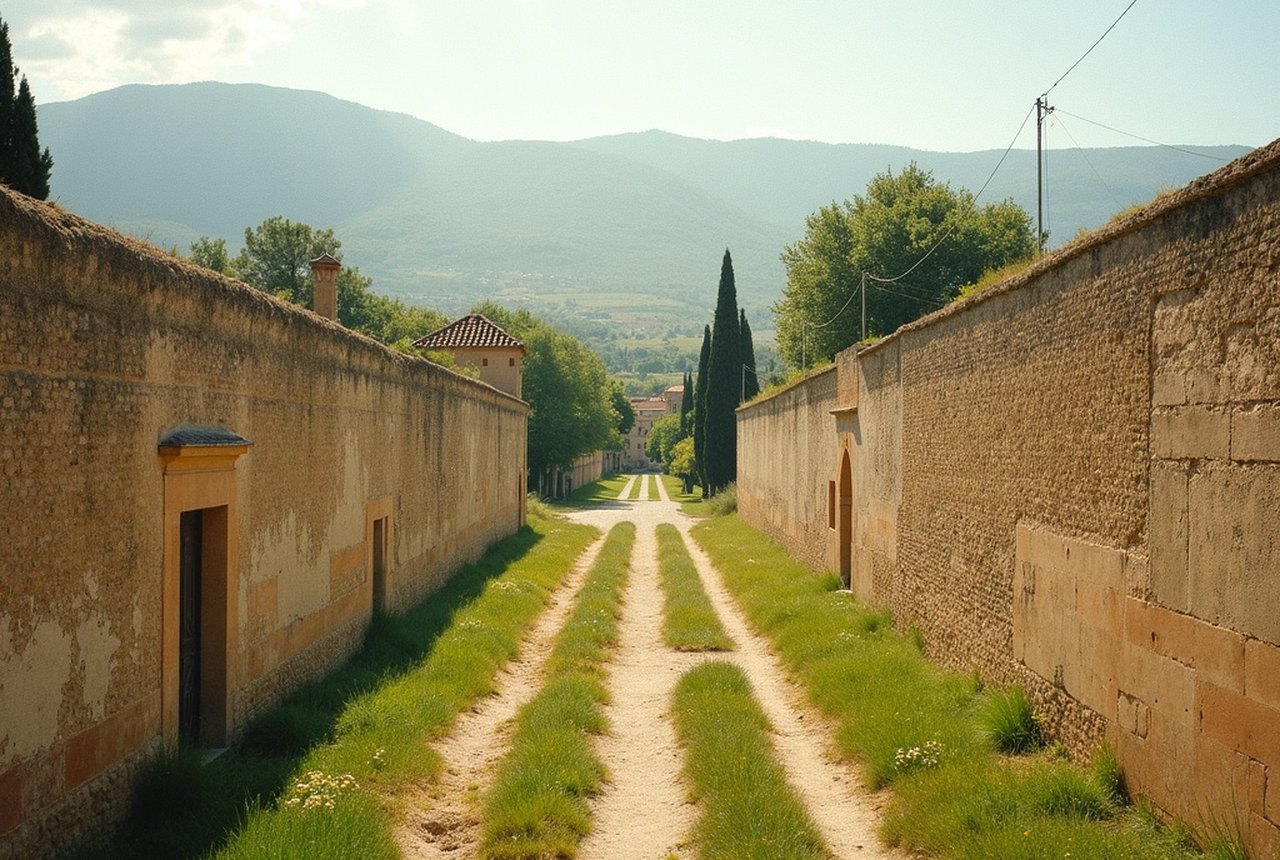
The Cité — that inner sanctum of Carcassonne, a UNESCO World Heritage site since 1997 — is home today to restaurants, hotels and a summer festival, but it has not entirely surrendered its gravity. Walk the lices, the grassed lists between the two concentric curtain walls, early in the morning before the tour coaches arrive, and the scale reasserts itself. The outer wall alone stretches for nearly a kilometre and a half. The inner wall, older and higher, hides the Château Comtal behind its own moat and drawbridge. This is not a château that happens to have walls around it; it is a fortified city that also contains a château — and the distinction matters when you are trying to understand what made Carcassonne so formidable, and so coveted.
03The Crusade and Its Consequences
The summer of 1209 was catastrophic for the Midi. Pope Innocent III had launched the Albigensian Crusade the previous year, directing the combined military force of northern French barons against the Cathar heresy that had taken deep root across Languedoc. The first and most notorious act came at Béziers, massacred in July with appalling efficiency. Carcassonne, seat of the young viscount Raymond-Roger Trencavel, was next.
Trencavel held the city for two weeks under siege before surrendering under terms — terms that were immediately dishonoured. He was taken prisoner, died in his own dungeon within months, and Carcassonne passed to Simon de Montfort, the crusade's military commander and its most ruthless instrument. The Cathar population was expelled from the city. De Montfort made Carcassonne his base, and it became the administrative heart of the newly conquered territory. The double walls and the Château Comtal that visitors explore today are substantially the work of successive French royal builders after the Crown absorbed the territory: Louis IX and Philip III reinforced and expanded the fortifications across the thirteenth century, turning a captured city into an impregnable frontier fortress facing the Crown of Aragon to the south. After the Treaty of the Pyrenees in 1659 folded Roussillon into France and the frontier moved to the Pyrenees, Carcassonne's military purpose evaporated almost overnight.
The Château Comtal, entered through a gatehouse of elaborate defensive ingenuity, rewards close attention. Its rooms contain a modest but well-curated permanent collection tracing the city's layers — Roman ceramics, medieval sculpture, documentation of the crusade and its aftermath. The rampart walk accessed from here gives the clearest sense of how the double-wall system worked: attackers who breached the outer wall would find themselves trapped in the lices, exposed to fire from the inner wall's towers, whose projecting forms were deliberately angled to eliminate blind spots. Murder holes in the gatehouse ceilings, arrow slits designed for overlapping fields of fire — every element of the architecture is an argument in stone about medieval military thinking.
04Viollet-le-Duc and the Debate He Started
By the early nineteenth century, Carcassonne had been reduced largely to a quarry. Locals helped themselves to cut stone; the walls crumbled; the towers lost their roofs. The writer and historian Prosper Mérimée, then Inspector General of Historic Monuments, visited in the 1830s and was appalled. His reports set in motion a rescue that would become one of the most consequential — and most debated — restoration projects in French history.
Eugène Emmanuel Viollet-le-Duc received the commission in 1853. He worked on the Cité until his death in 1879, producing a restoration of extraordinary ambition: repaired walls, rebuilt towers, and those distinctively pointed slate roofs on the towers that have become the city's visual signature. They are also the restoration's most contested feature. Viollet-le-Duc believed, on the basis of comparative study, that slate-capped conical roofs were architecturally appropriate for medieval towers in the region. His critics — and there were many, then and since — argued that the conical slate forms belong to northern France rather than the Midi, and that a historically accurate restoration would have used different materials and profiles. The argument has never entirely been settled, and it has sharpened over time into a broader debate about what restoration is actually for: returning a monument to an imagined original, or preserving what survives while being honest about the losses.
Viollet-le-Duc's own writings were clear that he understood restoration as creative interpretation, not archaeological facsimile. "To restore a building," he wrote, "is not to preserve it, to repair it, or to rebuild it; it is to re-establish it in a complete state such as it may never have been at any given moment." The honesty of that position is almost bracing. Whether the conical caps are 'wrong' matters less, perhaps, than the fact that without Viollet-le-Duc's intervention there would be very little left to argue about. The stones that were not carted away and built into the houses of the Bastide Saint-Louis, the lower town across the Aude, are here because he saved them.
| The critics | The defenders |
|---|---|
| He rebuilt his own romantic idea of a fortress, not the real one. | Without him there would be nothing left to argue about at all. |
| The conical slate roofs belong to the north, not to Languedoc. | Towers and battlements were largely rebuilt on real evidence. |
| What stands is a nineteenth-century vision of the Middle Ages. | The rescue earned UNESCO World Heritage status in 1997. |
05Beyond the Walls: Lastours and the Bastide
Carcassonne is the most visible monument to the Cathar wars, but it does not stand alone in the landscape. Eighteen kilometres to the north, up the gorge of the Orbiel through increasingly dramatic country, the Châteaux de Lastours present a quite different experience. Four ruined castles — Cabaret, Surdespine, Quertinheux and Tour Régine — occupy a single narrow ridge above the confluence of the Orbiel and the Grésilhou, their towers rising from the garrigue like broken teeth. This was the stronghold of Pierre-Roger de Cabaret, one of the most tenacious resisters of the Albigensian Crusade. Simon de Montfort besieged Lastours and failed; the castles were never taken by force during the crusade itself. They passed to the French Crown eventually through negotiation and inheritance, were reinforced across the thirteenth and fourteenth centuries, and then slowly fell into the ruin that makes them, arguably, more moving than Carcassonne — because here the stones lie where they fell. There is no Viollet-le-Duc to argue about. A viewing platform opposite the ridge offers the defining view: four crowns of broken masonry against a sky that, in high summer, is the particular blinding blue of the Cabardès country.
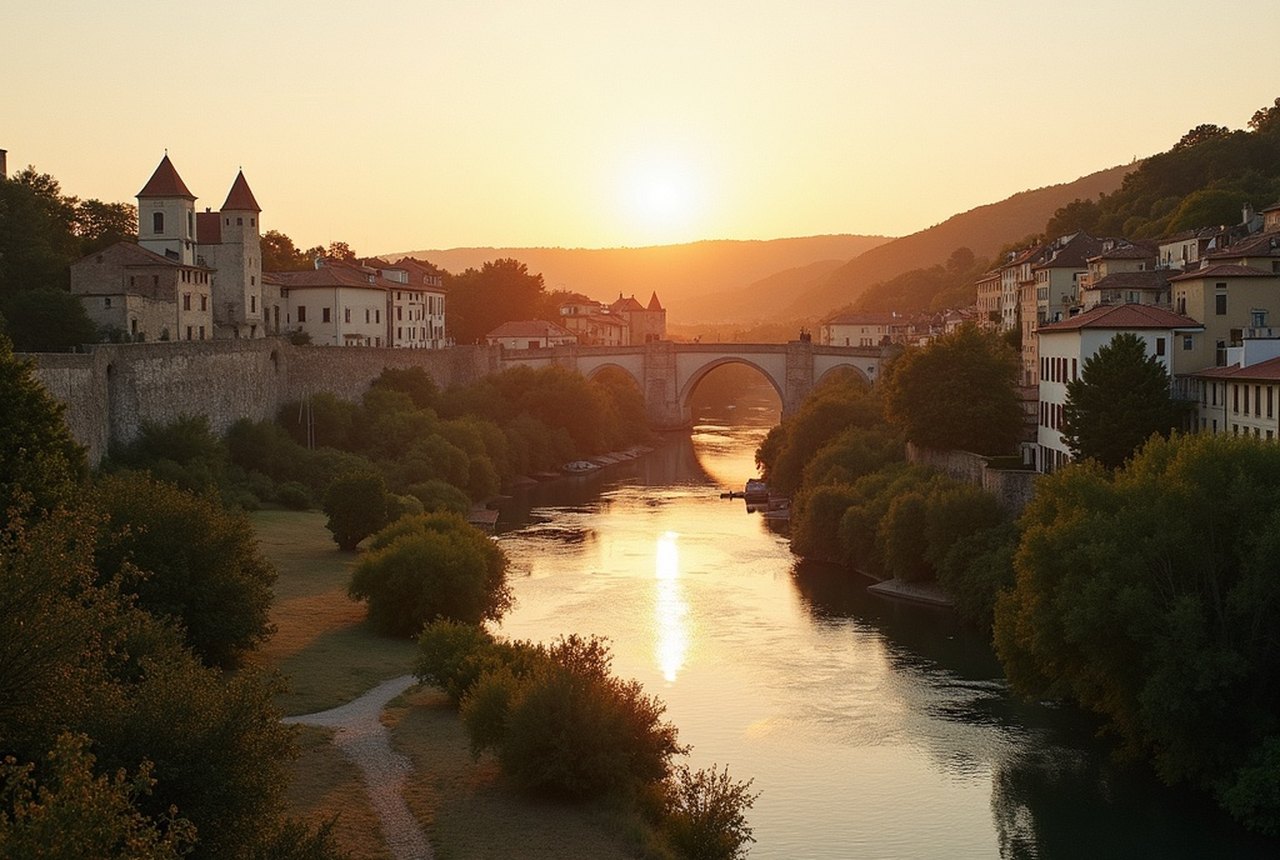
Back in Carcassonne, the Bastide Saint-Louis — the lower town laid out on a grid in the thirteenth century after the Cathar population was expelled from the Cité — offers a necessary counterpoint to the theatrical medievalism across the river. This is a lived-in, working French town: a market on the Place Carnot on Tuesday, Thursday and Saturday mornings, plane trees, a decent covered market, and the hôtels particuliers of the cloth merchants who made the lower town prosperous through the early modern period. Carcassonne's textile industry, which supplied much of France with fine woollen cloth from the seventeenth century onwards, left its traces in the handsome if slightly faded bourgeois architecture of the grid streets. The Bastide is not spectacular, but it is real in a way that the Cité, thronged with visitors and gift shops, cannot always manage. Crossing the Pont Vieux back toward the walled hill at the end of an afternoon, the Cité above still catching the light, you get the full picture: a city that has been many things — Visigoth capital, Cathar stronghold, crusader prize, royal fortress, textile town, romantic ruin — and that somehow contains all of them at once.
—A short chronology
- Pre-Roman/Roman erahill fortified; Romans build first substantial walls
- 1209Albigensian Crusade; Trencavel surrenders; de Montfort takes Carcassonne
- 13th centuryLouis IX and Philip III reinforce and expand royal fortifications
- 1659Treaty of the Pyrenees; Roussillon joins France; Carcassonne loses frontier role
- 1830sMérimée visits and reports; conservation campaign begins
- 1853–1879Viollet-le-Duc's restoration campaign
- 1997UNESCO World Heritage inscription
—People & places
Pope Innocent III
launched the Albigensian Crusade in 1208
Raymond-Roger Trencavel
Viscount of Carcassonne who surrendered the city in 1209
Simon de Montfort
northern French commander who led the crusade's military campaign
Prosper Mérimée
writer and Inspector General of Historic Monuments who triggered the rescue
Eugène Emmanuel Viollet-le-Duc
architect who led the controversial 19th-century restoration
Pierre-Roger de Cabaret
crusade-era lord of Lastours who resisted Simon de Montfort
Glossary
- Cité
- the medieval walled inner city of Carcassonne, distinct from the lower town
- Albigensian Crusade
- papal military campaign launched 1208 to eradicate Catharism in the Midi
- lices
- the grassed lists between Carcassonne's double concentric curtain walls
- murder holes
- ceiling gaps in castle gatehouses for dropping missiles on attackers
- arrow slits
- narrow wall openings allowing archers to shoot while remaining protected
- garrigue
- fragrant Mediterranean scrubland of herbs, shrubs and wild plants
- hôtels particuliers
- grand private townhouses typical of French historic city centres
- Cathars
- medieval Christian sect in southern France rejecting Catholic doctrine
- terroir