01Where the Rhône Meets the Sea
At the far eastern edge of Languedoc-Roussillon, where the Rhône exhausts itself into the Mediterranean, the land does not so much end as dissolve. The Camargue is neither entirely water nor entirely earth — it is something between the two, a vast, shimmering delta of some 150,000 hectares where lagoons blur into reedbeds, salt pans catch the light like broken mirrors, and the horizon is so flat and so wide that the sky becomes the dominant feature of the landscape. This is one of Western Europe's great wilderness edges, a UNESCO biosphere reserve since 1977, and a place that rewards patience and a tolerance for wind with sights available almost nowhere else on the continent.
The Rhône splits into two arms — the Grand Rhône to the east, the Petit Rhône to the west — and between them it has been depositing silt for millennia, building a wedge of delta land that pushes imperceptibly southward into the sea. The result is a mosaic of habitats layered over one another in gradients determined by salinity, flooding and soil. Move from the brackish lagoons of the interior outward toward the coast and you pass through reedbeds, sansouires (salt-tolerant marshes), rice paddies, grazing land, and finally the great white salt pans and sandy beaches where the delta meets open water. Each zone has its own community of plants and animals; each repays a separate walk, a separate hour of stillness.
02A Flora Built for Salt and Wind
Most plants would not survive here. The Camargue's soils are saline, often waterlogged, periodically desiccated by the fierce summer heat and the mistral — the north-westerly wind that tears down the Rhône Valley with a persistence that reshapes dunes and bends trees permanently southward. The plants that thrive have made dramatic accommodations to these conditions.
The sansouires are dominated by salicornia — glasswort — a succulent that looks less like a flowering plant than a series of jointed green fingers pushing up from the mud. In autumn it turns a vivid brick-red, colouring whole plains as effectively as any deciduous woodland. Alongside it grows sea purslane (Atriplex portulacoides), tamarisk with its feathery pink-grey plumes, and sea lavender (Limonium vulgare), which in late summer covers the salt marshes in hazy violet. These are halophytes — salt-lovers — evolved to exclude, excrete or simply tolerate the sodium concentrations that kill ordinary vegetation.
The freshwater and brackish zones support a different world. Common reed (Phragmites australis) forms dense reedbeds several metres tall, crucial nesting habitat for a dozen waterbird species. Yellow flag iris (Iris pseudacorus) lines the fresher margins. White and yellow water-lilies float on the étangs — the shallow lagoons — where the water is calm enough to allow them. On the higher, drier ground that was never truly marsh, the garrigue reasserts itself: kermes oak, wild rosemary, thyme, and the occasional maritime pine or stone pine shaped by the wind into something architectural and strange.
The rice paddies, concentrated in the northern Camargue where the land has been drained and managed since the mid-twentieth century, bring their own annual transformation. Through spring and early summer the fields are flooded and brilliant green; by late summer they have turned gold, and harvest season runs into October. Camargue rice — a protected designation, Riz de Camargue IGP — includes both white and the distinctive whole-grain red variety, the latter with a nutty flavour and firm texture that makes it the natural partner for gardiane, the local beef-and-red-wine stew.
03Flamingos, Bulls and the Birds of the Étangs
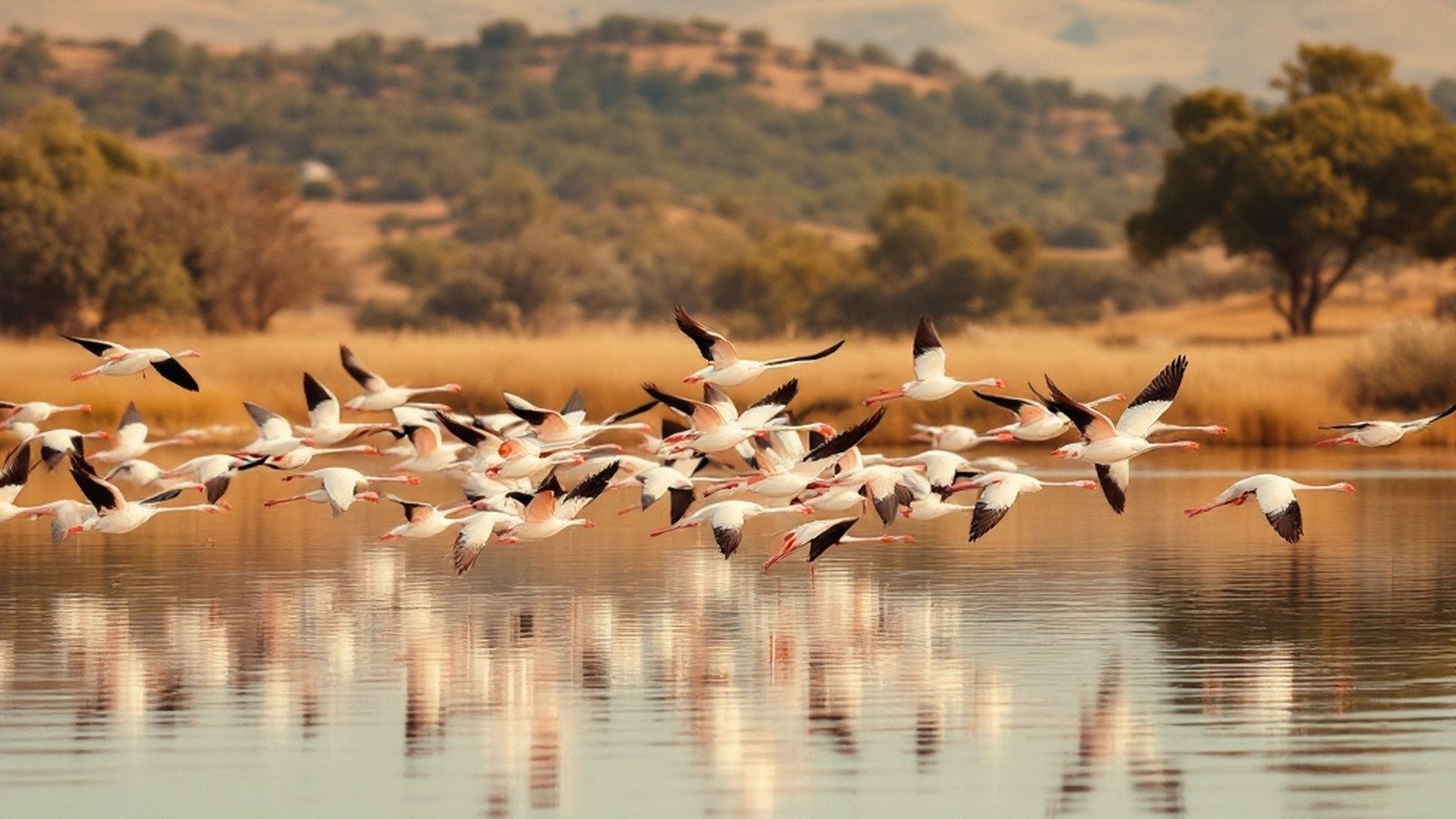
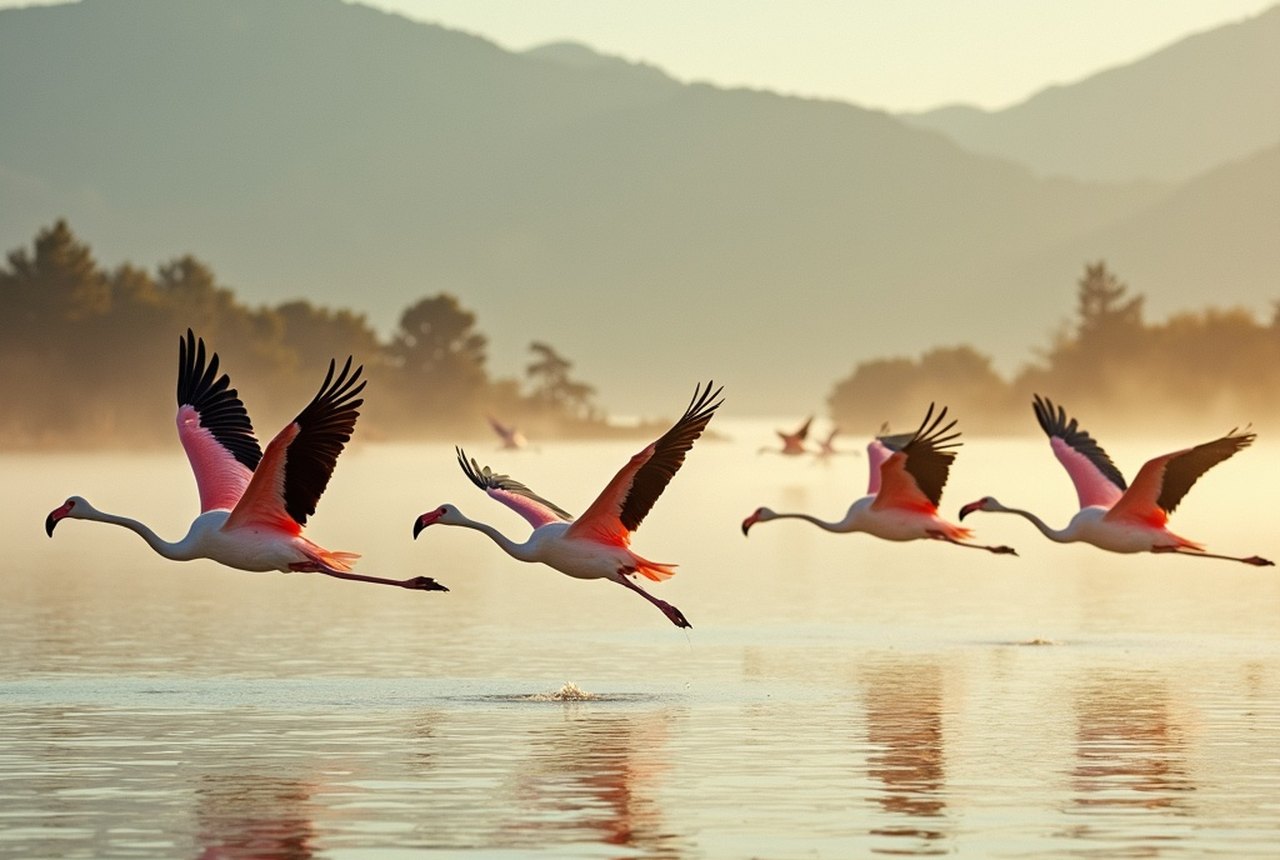
The greater flamingo (Phoenicopterus roseus) has become the Camargue's unofficial emblem, and with good reason. Colonies of many thousands gather on the shallow lagoons — most famously on the Étang de Vaccarès and at Gines near Aigues-Mortes — where they feed by sweeping their kinked bills upside-down through the water, filtering out the tiny crustaceans, algae and brine shrimp that give their plumage its pink. Seeing a flock take flight — a sudden eruption of carmine and white against a blue sky — is one of those experiences that resists easy description and refuses to be forgotten.
But the flamingo is only the most visible of a remarkable avifauna. The Camargue sits on one of Europe's major migratory flyways, and in spring and autumn it fills with birds passing between Africa and northern Europe. Purple herons, little egrets, squacco herons and night herons breed here in the reedbeds. Black-winged stilts pick their way through shallow water on improbable pink legs. Marsh harriers quarter the reed tops. In winter, tens of thousands of wildfowl — wigeon, teal, pintail, garganey — crowd the lagoons, and hen harriers ghost across the sansouires in fading light. Bee-eaters and rollers arrive in May, their colours extravagant against the muted palette of the delta.
The Camargue also shelters animals more usually associated with open steppe or semi-arid range. The black Camargue bull — taureau camarguais — is a hardy, semi-wild bovine of ancient lineage, descended from cattle that may have grazed these marshes since antiquity. They are smaller and more agile than domesticated cattle, with long, lyre-shaped horns, and they roam in manades — herds — across the open grazing land, largely managing themselves. Their meat, lean and richly flavoured, appears on menus throughout the region: the gardiane de taureau made with the local wine and served on local rice is a dish of genuine regional identity.
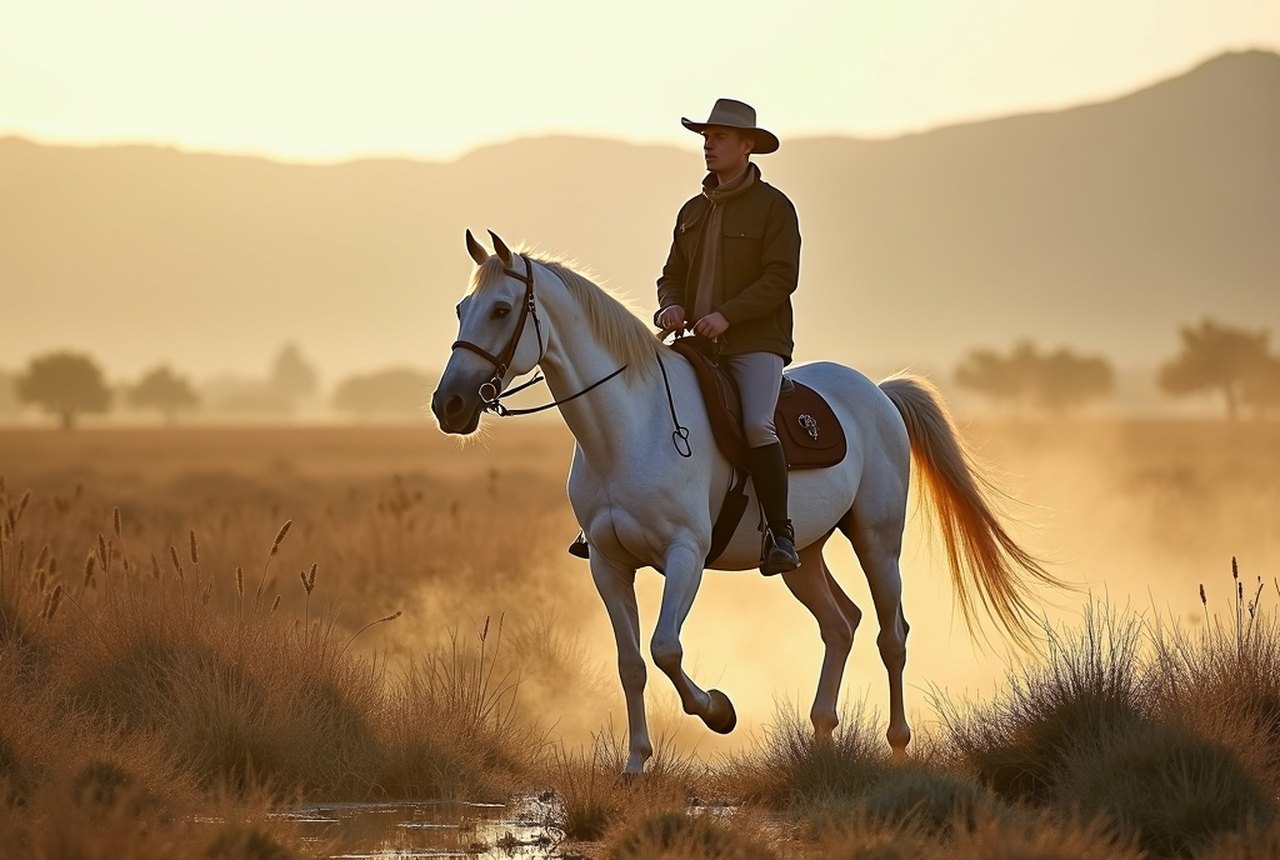
The white Camargue horse — cheval camarguais — is, if anything, even more emblematic. Foals are born dark grey or brown and lighten over years to the pale, almost luminous white for which the breed is known. These are sturdy, sure-footed animals of great antiquity, adapted to the boggy terrain and sharp-stalked vegetation of the marshes. They carry the gardians, the mounted herders of the Camargue, who manage the bulls and maintain a tradition of horsemanship that owes something to the ranching cultures of both Spain and the French interior. The gardian is a figure of genuine historical depth — a herder, a horseman, a custodian of a particular relationship between people and a difficult landscape. The brotherhood of gardians (confrérie des gardians), based in Arles, has preserved these traditions actively; their annual festival in late April, held around Saint George's Day, remains a vivid expression of a living culture rather than a costumed performance.
04Salt and the Edges of the Sea
At the delta's southern and western edges, the industrial and artisanal salt works of the Camargue transform the seascape into something almost abstract. The salins — great shallow pans flooded with seawater and left for the sun and wind to do their work — produce both coarse salt (gros sel) and the prized fleur de sel, the fine, fragile crystals that form at the surface under ideal conditions and are harvested by hand with a flat wooden rake. Fleur de sel de Camargue has become one of the region's most-sought condiments: delicate, moist, barely bitter, used not in cooking but as a finishing salt.
The salt pans themselves are a habitat. Their high salinity excludes most competition, but the micro-organisms that colour the water pink and red — halophilic algae, in particular — provide the food chain that supports the flamingos and a suite of specialist waders. Avocets breed on the pan margins. Slender-billed gulls and Mediterranean gulls circle overhead. In late summer, when evaporation is at its peak and the salt crystallises white against the blood-coloured water, the aesthetic is extraordinary — less like farmland than like something at the edge of habitability, which in a sense it is.
The Camargue resists tidy categories. It is a natural wilderness that is also an agricultural landscape, a migratory staging post that is also a permanent home, an elemental emptiness that is also, once you learn to look slowly, almost implausibly full. Come in April for wildflowers and arriving migrants; come in June for flamingo colonies at full strength; come in November for the wildfowl and a quality of light — low, grey, immense — that makes the whole delta seem to breathe. Arrive early, take the small roads, and stop when something moves at the edge of your vision. It almost always repays the attention.
—A short chronology
- AntiquityCamargue cattle possibly grazing the delta marshes from this period
- mid-20th centuryrice paddies established in drained northern Camargue
- 1977UNESCO biosphere reserve designation
—People & places
Camargue
Rhône delta wetland region at eastern edge of Languedoc-Roussillon
confrérie des gardians
brotherhood of Camargue herders based in Arles, preserving mounted herding traditions
Étang de Vaccarès
major Camargue lagoon, key flamingo and waterbird habitat
Aigues-Mortes
historic walled town on western Camargue edge, near salt works
Arles
gateway city to the Camargue, seat of the gardians' brotherhood
Riz de Camargue IGP
protected-designation rice grown in the northern Camargue, including red variety
Glossary
- sansouire
- salt-tolerant marsh habitat characteristic of the Camargue delta
- halophyte
- plant adapted to survive and grow in highly saline soils
- manade
- semi-wild herd of Camargue bulls managed by a gardian
- garrigue
- fragrant Mediterranean scrubland of herbs, shrubs and wild plants
- mistral
- fierce north-westerly wind channelled down the Rhône Valley
- fleur de sel
- fine hand-harvested salt crystals forming at the surface of salt pans
- étang
- shallow brackish or saltwater lagoon typical of the Camargue
- gardian
- mounted herder of the Camargue, managing bulls and horses on horseback
- gardiane
- Camargue-style red-wine beef stew served with white or red rice
- IGP
- Indication Géographique Protégée; EU protected designation of geographic origin